
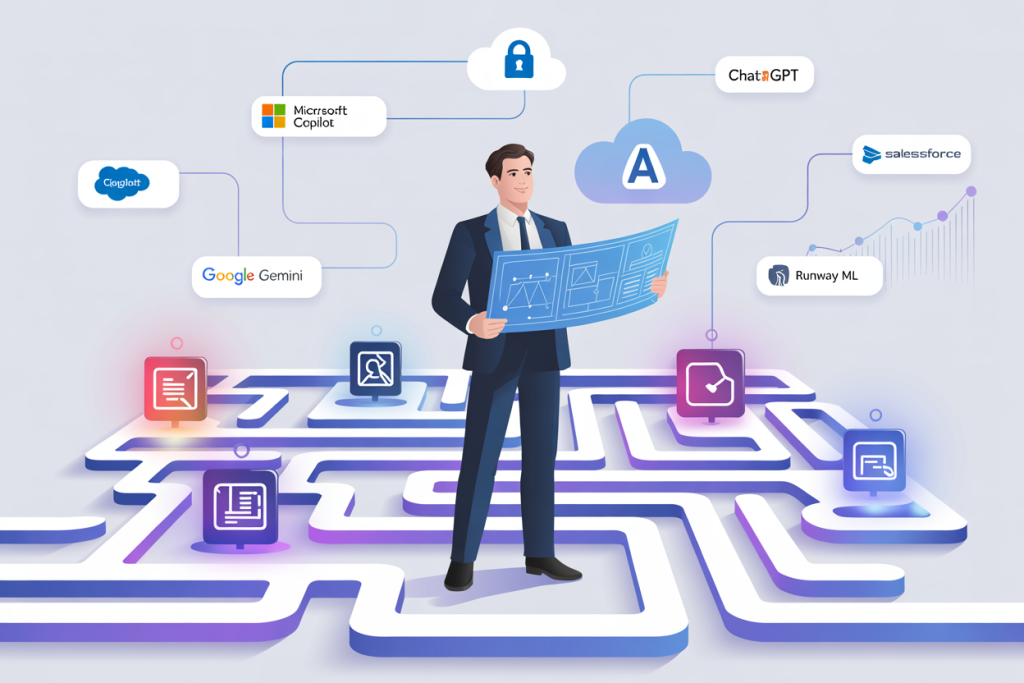
Every turn in today’s AI maze reveals another shiny solution, each promising to revolutionize your workflow. But with dazzling innovations appearing at every corner, the real challenge lies in cutting through the noise and identifying the tools that will make a meaningful difference for your organization. It’s not just about being dazzled by the latest trends; it’s about carefully weeding through the flood of possibilities to discover the solutions that will truly transform the way you work. Let’s chart a course through this complex landscape, so you can focus on what matters: finding AI tools that genuinely move the needle for your business.
 The key is to start with purpose. What exactly are you trying to accomplish? AI tools are most effective when given focused, specific tasks. Just like children thrive with simple instructions, AI agents perform best when they’re not overwhelmed with too many directives. Each agent that you find will give a specific purpose for why and what it was built to accomplish. If it doesn’t say, ask the agent, it will tell you its purpose. If your goal is to analyze data, summarize documents, generate content, or work with images and video, you’ll want to choose a tool that excels in that specific area. Understanding your objective is the first and most important step.
Next, identify the required data. This is the information your AI tool needs for its intended purpose, such as customer data, sales numbers, or any data directly tied to your goal. For searching across emails, chats, meetings, or documents, integrated solutions such as Copilot for M365, Google Gemini, or Zoom agents provide seamless connectivity within their respective ecosystems. If your work is primarily based in Salesforce or an ERP, leveraging that platform’s dedicated AI tool may be most effective. Specialized platforms like ideogram.ai, invideo.io, and runwayml.com excel in generating high-quality images, graphics, and videos. For requirements that span multiple platforms, both Microsoft Copilot Studio and ChatGPT support connectors to third party services such as Salesforce, Dynamics, social media, and weather data, facilitating broad and versatile integration.
 Security is another critical factor. If you’re uploading sensitive data, make sure you understand whether the AI tool is public or private. Microsoft Copilot, for example, respects your organization’s existing permissions and keeps your data within your Microsoft tenant—meaning your emails, chats, and files stay secure and internal. On the other hand, depending on your subscription tier, your data might be used to train future models unless you opt out. If it’s free, you’re probably making your data available to the public.
Even with a clear purpose and the right agent, you’ll still face the AI learning curve. Think back to the early days of Excel. Every company/department had a power user who built complex spreadsheets and macros that saved hours of work. We sent these individuals to Excel bootcamps. The spreadsheets they created were eventually handed off to team members and, if they were really good, given to IT to be scaled into enterprise solutions.
We’re seeing the same pattern with AI. Low-code platforms like ChatGPT’s custom GPTs or Microsoft Copilot Studio allow users to build powerful tools without needing to be developers. But there is a learning curve. That’s why it’s important to identify the AI enthusiasts within your organization, those curious, tech-savvy team members who are eager to experiment. Give them the time and resources to build proof-of-concept tools. The most effective solutions will naturally rise to the top, and your IT team can then help scale them into fully integrated systems.
In short, choosing the right AI tools isn’t about picking the flashiest option, it’s about aligning the tool’s strengths with your business needs, understanding your data environment, and empowering your team to innovate. With the right approach, AI can become more than just a buzzword, it can be a true business accelerator.
/////////////////////
ABOUT THE AUTHOR
 Mark Veldhoff is the CEO and Founder of Envizion IT, where he helps businesses navigate the evolving landscape of technology with clarity and purpose. With over 20 years of experience in IT cost mitigation and infrastructure optimization, Mark has built a reputation for delivering lean, cost-effective solutions without compromising quality. Today, he’s focused on guiding organizations through the complexities of AI adoption—helping them identify the righttools, align them with business goals, and empower internal teams to innovate. Mark’s approach blends strategic insight with hands-on experience, making advanced technologies like AI accessible and actionable for companies of all sizes. Through Envizion IT, he continues to champion personalized, scalable solutions that drive real business value.
/////////////////////////////
This article has also been published in the September/October 2025 edition of The West Coast Way (a publication of the West Coast Chamber of Commerce).


